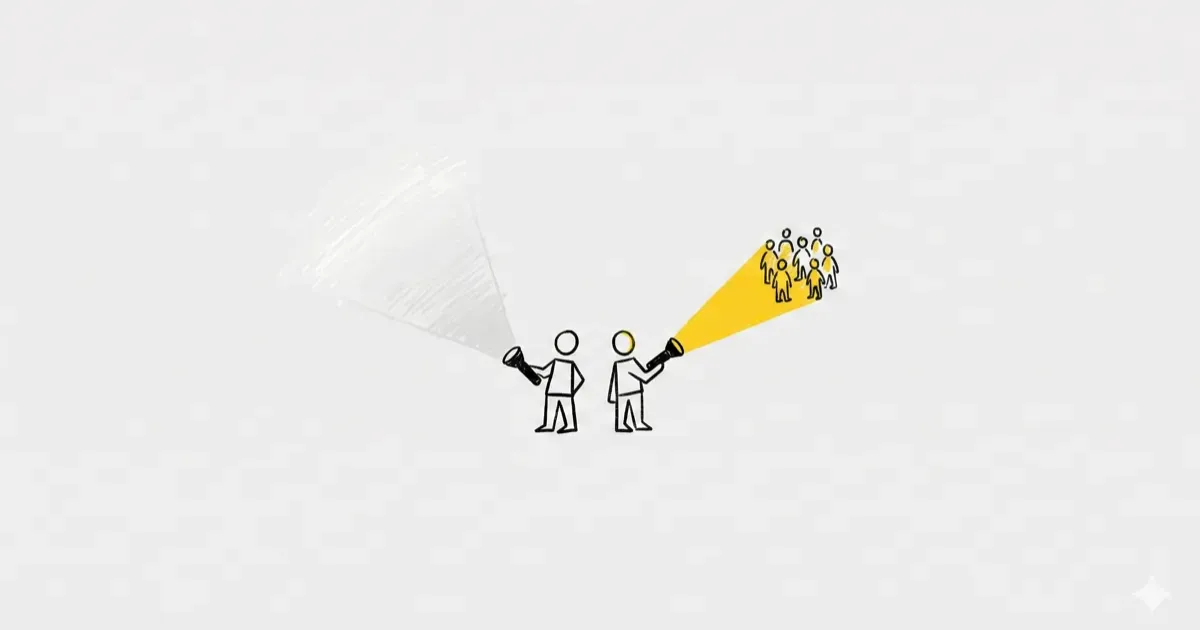
You picked your niche. You built the thing. You posted about it. Crickets.
The product works. The landing page looks fine. But nobody's signing up and you can't figure out why.
The problem isn't your product. It's that you skipped the step that makes distribution possible.
Positioning is a distribution decision
Most builders think of positioning as a branding exercise. Pick a tagline. Write some landing page copy. Choose your colors. Move on.
But positioning isn't about how your product looks. It's about who it's for. And that decision changes everything about where you show up and what you say when you get there.
When you pick "developers" as your target, something clicks. Suddenly you know exactly where to go: dev subreddits, webdev Twitter, VS Code communities, Hacker News. The content angles write themselves. The communities become obvious.
When your target is "everyone"? Where do you post? Everywhere. Which means nowhere effectively.
The "built for everyone" trap
This is the most common pattern I see working with early-stage builders. They have a solid product. They even have a landing page. But when you ask "who is this for?", the answer is some version of "anyone who needs it."
That answer feels safe. Casting a wide net feels like you're maximizing your chances. In reality, you're making distribution almost impossible.
Here's why: distribution requires specificity. You need to know:
- Which communities your users hang out in
- What language they use to describe their problems
- What content would make them stop scrolling
"Anyone who needs a better CRM" gives you nothing to work with. "Solo founders who are tracking deals in a spreadsheet" gives you everything.
The three questions before you launch
Before you write a single line of marketing copy, answer these three questions:
1. Who specifically is this for?
Not a demographic. A specific person with a specific problem. "Freelance designers who lose track of client feedback" is good. "Creative professionals" is useless.
2. Where do they hang out online?
Name the subreddits, the X communities, the Discord servers, the forums. If you can't name at least three specific places, your audience is too broad.
3. What would you post there on day one?
Not a launch announcement. A genuine contribution. What would you say in that community that would make people think "this person gets it"?
If you can't answer all three, you're not ready to launch. You're ready to narrow.
From positioning to channels
Once you've made the positioning decision, your distribution channels reveal themselves.
A tool for indie hackers? You know exactly where they are: Indie Hackers forums, r/SideProject, build-in-public Twitter, and builder Discord servers.
A tool for teachers? Completely different map: education subreddits, teacher Facebook groups, education conferences, school admin newsletters.
The positioning decision IS the distribution decision. It's not a prerequisite to distribution. It's the same thing.
What about audience mismatch?
Here's a tricky situation that comes up often: you have an existing following, but it's the wrong audience for your product.
Maybe you built a following around tech commentary but your product serves fitness coaches. Your 500 followers aren't going to convert because they're not your users.
There are three ways to handle this:
Go to a different channel entirely. If your users live on Reddit or in niche forums, go there directly. Your X follower count doesn't matter in those communities. This is usually the highest leverage move.
Start a separate product account. When your product serves a completely different audience from your personal brand, a dedicated account keeps both audiences coherent.
Lean into the overlap. But only when it actually exists. If you're a developer who built a developer tool, your existing dev following IS your target audience. In this case, connecting your content to your product makes sense.
The key question: would your current followers plausibly use this product? If not, don't try to convert them. Find the right room.
Start before you're ready
The best time to do this positioning work is before you write your first line of code. The second best time is right now.
Pick your specific audience. Find three places they gather online. Write something useful there this week. That's distribution. Everything else is a side effect.
Your landing page copy, your feature priorities, your content strategy: they all flow from that one positioning decision. Make it specific, and distribution stops being a mystery.