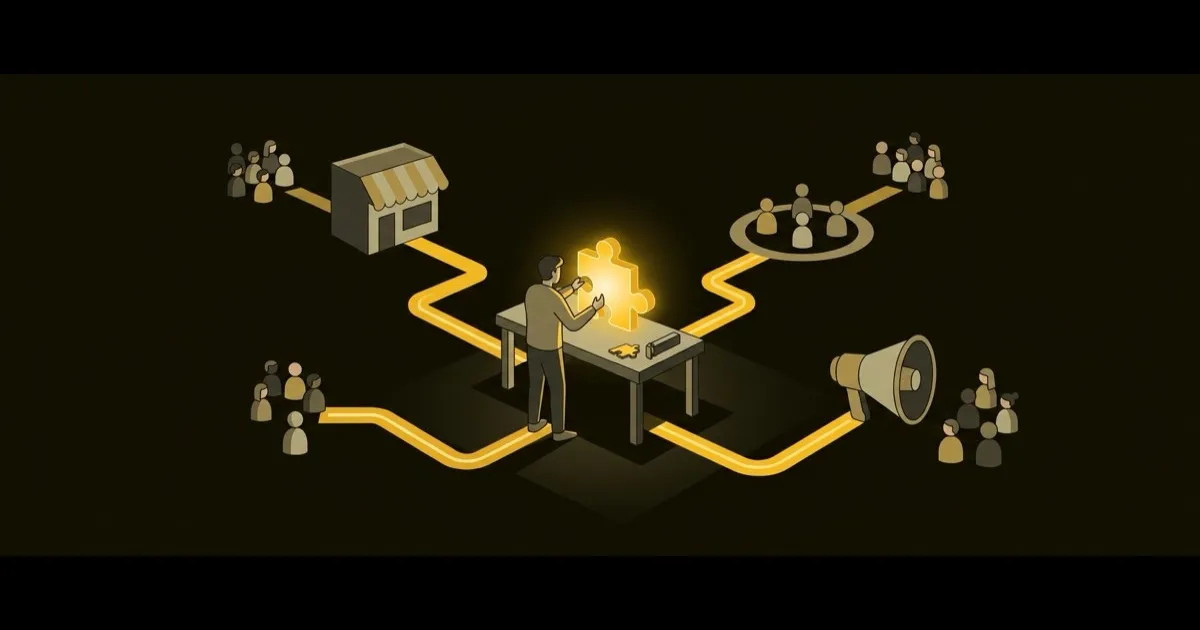
You built a browser extension. It works, it solves a real problem, and you're proud of the code. But the Chrome Web Store isn't sending you users, and your listing is buried under a hundred similar tools. The install count is stuck in double digits.
The distribution problem for browser extensions
Browser extensions have a strange distribution challenge. The Chrome Web Store gives you a free storefront, but almost no discovery. There's no "trending" section that drives meaningful traffic. Users search for a specific solution, pick one of the top three results, and leave. If your listing doesn't rank for the right keywords, you're invisible. And because extensions live inside the browser, they're hard to demo. The install friction (navigate to store, click install, grant permissions) kills casual sharing.
Channels that actually work
1. Chrome Web Store SEO
This is the one channel that works 24/7 without your involvement. The Web Store search algorithm is simpler than Google, so small optimizations make a real difference. Put your primary keyword in the extension name (e.g., "Tab Manager Plus" not "Tabify"). Write the first 132 characters of your description like a search ad, because that's all users see in results. Pick a category where you can rank top 5 rather than getting buried. GoFullPage grew to 4 million users almost entirely through organic Web Store discovery.
2. Reddit and niche communities
Reddit drives small but highly targeted batches of installs, typically 20-50 per well-placed post. The key subreddits: r/chrome_extensions (dedicated discovery community), r/SideProject (indie builders who try everything), r/webdev or r/javascript for developer tools, and r/productivity or r/getdisciplined for productivity extensions. Momentum's breakout came from a single r/productivity post that caught fire, leading to CNET coverage and 100k users in four months. Don't drop a link and leave. Frame your post around the problem you solved and ask for feedback.
3. Product Hunt
Product Hunt is the best platform for a concentrated spike of installs. A solid launch can drive 50 to 200 installs in a day. CSS Scan got 1,917 upvotes on its second launch. Spider hit #1 Product of the Day and made $10k in two months. Launch at 12:01 AM Pacific on a Tuesday through Thursday. Have your screenshots, demo GIF, and a clear one-liner ready. Engage with every comment on launch day.
4. Hacker News (Show HN)
Show HN posts work well for developer-facing extensions. Post between 9-11 AM EST on weekdays. Keep the title factual: "Show HN: I built a Chrome extension that does X." Vimium, the keyboard navigation extension, spread almost entirely through developer word-of-mouth in communities like HN and Vim forums. If your extension solves a real developer pain point, this audience will share it for you.
5. Content marketing and SEO
Write blog posts targeting the problem your extension solves, not the extension itself. If you built a tab manager, write about "how to manage 100 open tabs" or "Chrome using too much memory." These posts rank on Google and funnel people to your Web Store listing. Publish on your own blog, Medium, or Dev.to. The Web Highlights extension scaled to 100k users primarily through SEO content that brought organic search traffic, with no paid marketing budget at all.
6. Build in public on X/Twitter
Share your install numbers, user feedback, and weekly updates. The BlackMagic extension grew to $3k/month in revenue through building in public on X, where its target audience (Twitter power users) already lived. This compounds slowly but creates a consistent trickle of installs.
Common mistakes browser extension builders make
- Ignoring the Web Store listing. Most builders upload default screenshots and a two-sentence description. Treat your listing like a landing page: benefit-focused copy, 3-5 screenshots with text overlays explaining each feature.
- Launching on Product Hunt before getting reviews. A listing with zero reviews kills trust. Get 10-20 reviews from your network first. Add a "Rate this extension" prompt that triggers after a user gets value (e.g., after 5 uses or 7 days active).
- Requesting unnecessary permissions. Momentum lost over 50% of its users overnight when a weather feature required new geolocation permissions, causing Chrome to disable the extension for everyone. Only request the minimum permissions you need.
- Marketing to other developers instead of users. Unless your extension is a devtool, your audience isn't on Hacker News. A tab manager's users are in r/productivity, not r/webdev. Match the channel to the actual user.
Real examples
Momentum started as a Photoshop mockup that sat on a shelf for six months. After launching on the Chrome Web Store, it grew through a viral Reddit post on r/productivity, which led to press pickups from CNET and international tech blogs. It hit 100,000 users in four months with zero marketing spend. Community seeding plus press snowball.
GoFullPage took the opposite approach: pure organic growth through Chrome Web Store SEO. The extension grew to 4 million users and 53,000 reviews before the creator added a premium tier at $1/month, already making $10k/month by then. If your listing ranks well, the store itself becomes your distribution channel.
Dark Reader was built by Alexander Shutov in 2014 because his eyes hurt from bright screens. The extension grew through word-of-mouth and GitHub contributions, eventually becoming one of the most-installed extensions across Chrome and Firefox. Open-sourcing the code created a community of contributors who became its marketing engine.
Find your distribution channels
Every browser extension has a different ideal distribution map. It depends on who exactly you're building for and what problem you're solving. The channels that work for a developer productivity tool are different from what works for a shopping coupon finder or a dark mode extension.
Want to find out which channels will work for YOUR browser extension? Stride's free audit analyzes your product and audience to surface the gaps.